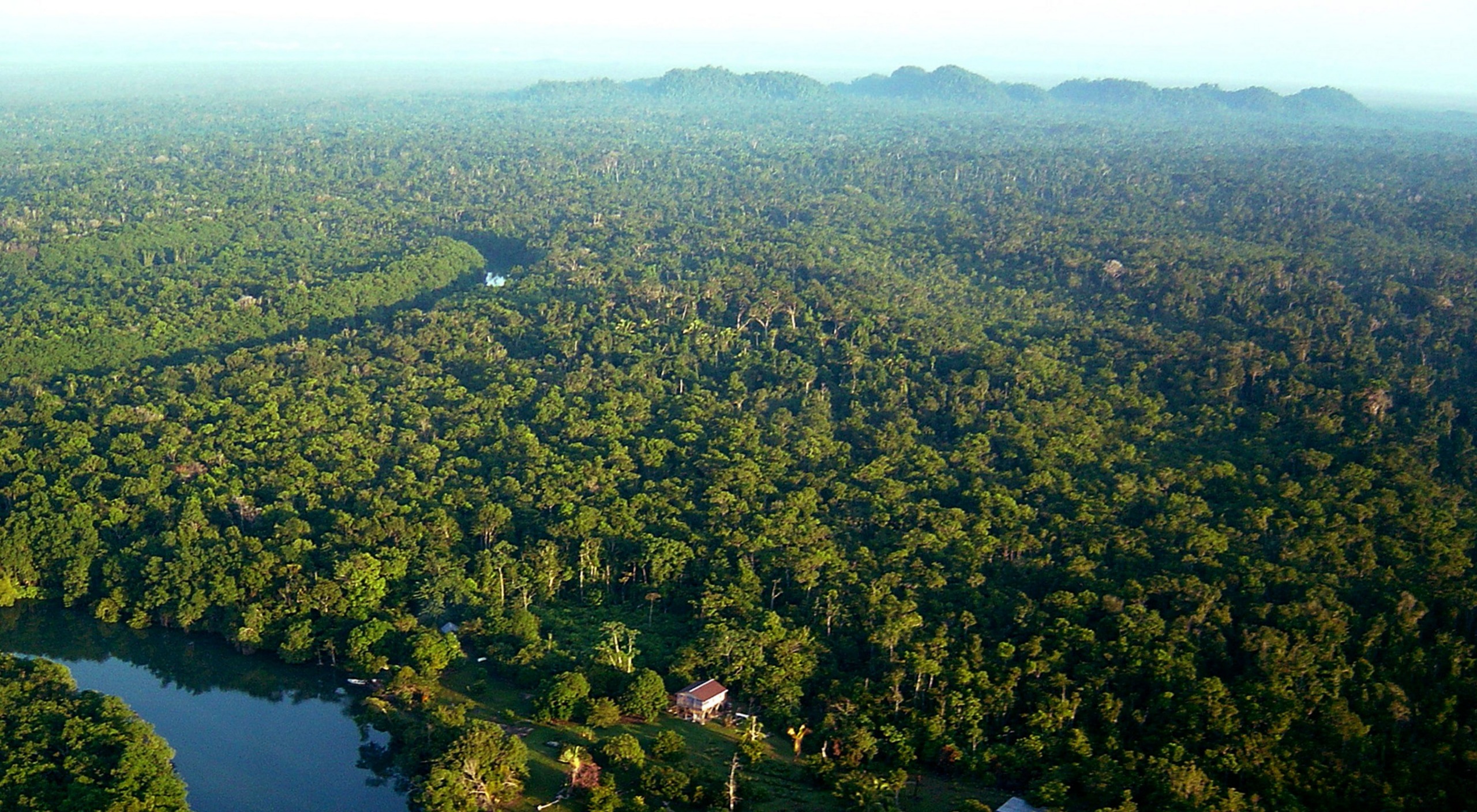
Lubaantun
Lubaantun is a Maya site in southern Belize, remarkable for its structures built from slate blocks assembled without mortar. Perched on a ridge above the Columbia River valley, it offers a rare glimpse into the late Classic period, far from the crowds.
Lubaantun — "place of fallen stones" in Maya Chol — is an archaeological site located in Toledo District, in southern Belize. Built without mortar or carved stelae, it stands apart through a unique construction technique found nowhere else in the Maya world. Perched on a natural ridge above the Columbia River, the site reveals a rare snapshot of a late Maya city that flourished between the 8th and 10th centuries.
Quick facts
- Entrance : paid admission (managed by the Institute of Archaeology of Belize)
- Recommended duration : 1.5 to 2 hours on site
- Access : from Punta Gorda, road to San Pedro Columbia then track; 4x4 vehicle recommended during rainy season
- Dress code : closed-toe shoes essential, uneven terrain
- Accessibility : limited, trails not developed
What to see
The site comprises five main plazas surrounded by platforms and pyramids. The structures are built from precisely cut slate blocks, stacked dry with remarkable precision. No stelae, no hieroglyphic inscriptions have been found here — a singularity that sets Lubaantun apart from most other Maya cities in the region.
Tropical vegetation surrounds the structures, some still partially covered by jungle. A small museum on site displays artifacts discovered during excavations, including ceramic figurines and obsidian objects.
History and context
Lubaantun was occupied primarily between 700 and 900 CE, during the Late Classic period. British excavations in the early 20th century brought the site to light. It was here that adventurer Frederick Mitchell-Hedges claimed to have discovered in 1924 the famous "crystal skull," an object whose pre-Columbian authenticity has since been disproven by scientific analysis.
The site likely served as an administrative and ceremonial center for the Toledo region, maintaining trade exchanges with coastal communities and cities in the Petén of Guatemala.
Highlights of the visit
Plaza 4 and its pyramids
The central plaza is flanked by the best-preserved structures. From the summit of the main pyramid, views across the canopy and Columbia River valley are expansive and worth the climb.
The mortar-free construction technique
Examining the joints between slate blocks up close reveals exceptional craftsmanship. The stones interlock with such precision that the structures have withstood the centuries without any binding agent.
The site's small museum
The ceramic figurines on display illustrate daily life and ritual practices of the inhabitants. Obsidian pieces testify to long-distance trade networks.
Photography tips
Morning light filters through the canopy, illuminating the slate stones in golden tones. Arriving early allows you to avoid heat haze and have the site largely to yourself. Angles from the pyramid summits capture the surrounding jungle beautifully. No known photography restrictions exist on site.
Location and access
Lubaantun is located approximately 45 km northwest of Punta Gorda, the main town of Toledo District. Paved road leads to the village of San Pedro Columbia; a dirt track then connects to the site. During the rainy season (June–November), a four-wheel-drive vehicle is strongly recommended. No direct public transport is available; local agencies in Punta Gorda offer organized excursions.
Nearby
- Nim Li Punit — another Maya site in Toledo District, known for its carved stelae, among the tallest in Belize.
- Punta Gorda — port town and logistical hub for exploring southern Belize, with local market and access to island cayes.
- Blue Creek Cave — swimmable cave in dense jungle setting, near the village of Blue Creek.
Frequently asked questions
The dry season, February to May, offers the best access conditions. Tracks are passable and less dense vegetation makes exploring the structures easier.
Yes. Nim Li Punit lies on the route between Punta Gorda and Lubaantun. A well-organized day allows you to visit both sites, starting with Nim Li Punit in the morning.
A caretaker is usually present at the entrance. A local guide is not mandatory but greatly enhances the visit, particularly for understanding the construction technique and site history.
The terrain is uneven and some climbs are steep. Closed-toe shoes and constant supervision are necessary. Children in good physical condition generally enjoy exploring the pyramids.
Frederick Mitchell-Hedges claimed to have discovered it here in 1924. Subsequent analyses demonstrated that this quartz skull was crafted with modern tools and is not of pre-Columbian origin.

Interested in this visit?
We can include it in your personalised itinerary.